As DC and HPC charging networks scale, operators keep hitting the same limit: the local grid connection wasn't built for the load it's now expected to carry.
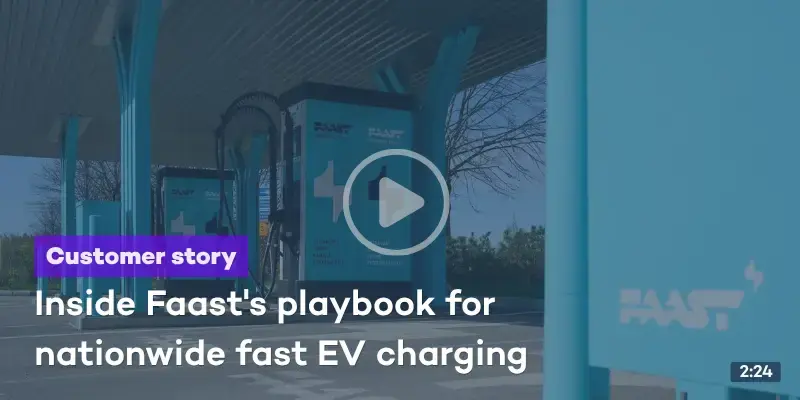
Two solutions solve this without waiting months for a grid upgrade: dynamic load management and battery energy storage system (BESS). Both are already being deployed together at real charging sites – Finnish network Faast, for example, pairs its nationwide DC fast-charging stations with on-site battery storage to support high, consistent charging power at every location.
Beyond solving a technical constraint, both levers have a direct economic case: avoiding or delaying a costly grid connection upgrade, reducing peak demand charges, and getting more revenue-generating chargers onto a site without expanding its power supply.
In this article, we take a closer look at how each approach works, where they differ, how on-site renewables fit into the picture, and how to decide which combination fits your network.
/Faast/Virta_X_Faast-photo_Ville_Vappula_Z8X0809-web.webp?width=1920&height=1080&name=Virta_X_Faast-photo_Ville_Vappula_Z8X0809-web.webp)
Why static power allocation doesn't work for multi-charger DC sites
Static load management sets a fixed power cap per charger and per site. It's simple, and it's the default approach at many mixed AC/DC sites with only a few charge points.
But at a DC or HPC site with several 150 kW+ chargers – the kind you'll typically find at EV charging hubs or dedicated ultra-fast charging locations – static caps are inefficient by design: if power is split evenly across chargers regardless of how many vehicles are actually plugged in, most of that capacity sits unused most of the time, while the site's grid connection still has to be sized for the theoretical worst case of everyone charging at once.
For a network of a few large loads rather than many small ones, that gap between "worst case" and "typical case" is expensive. It's the reason dynamic approaches matter more at DC/HPC sites than at residential or small AC installations.
Lever 1: Dynamic load management
Dynamic load management (DLM) continuously measures how much power is actually being drawn across a site and reallocates it in real time. If only one vehicle is charging, it gets the full available power. As more vehicles plug in, the system redistributes power across all active sessions – automatically, without derating every charger to a fixed cap.
In practice, this means:
- The site's grid connection can be sized closer to realistic average demand rather than theoretical peak demand.
- Sessions still get meaningfully fast charging even when several vehicles are connected simultaneously, instead of everyone getting a diminished, evenly-split rate.
- Operators avoid or delay a costly grid connection upgrade as they add more chargers to a site over time.
This is a software-side solution: it requires a charge point management system (CPMS) that can monitor and control power distribution across the network in real time, but no additional hardware on-site. Virta's own energy management solutions, including Congestion Management, work exactly this way.

Lever 2: Battery storage (BESS) as a grid buffer
Battery energy storage system (BESS) takes a different approach to the same problem. Instead of managing how power is split across chargers, a BESS installed at the site draws power from the grid – or from on-site renewables such as solar, where available – steadily, even when no vehicle is charging, and stores it.
When a vehicle plugs in and needs a high-power burst, the battery discharges to meet that demand, supplementing (or in some designs, entirely replacing) grid power for that session.
The effect is similar to load management from the grid's perspective: peak demand on the grid connection is smoothed out. But the mechanism is different – it's a hardware buffer rather than a software allocation rule.
Faast's nationwide Finnish charging network is a good real-world example: its DC stations run on the Virta platform, with on-site battery storage helping the network guarantee high minimum charging power rather than just headline peak speeds – even at busy hubs.
BESS is particularly relevant for:
- Sites in genuinely grid-constrained locations, where even smart software-side allocation can't free up enough capacity.
- Sites that want to pair charging with on-site renewable generation or take advantage of time-of-use electricity pricing.
- Operators who want backup capacity for grid outages, not just peak shaving.
Where on-site renewables fit into the picture
Solar (and less commonly, on-site wind) adds a third variable to the same problem, and it interacts with both levers above rather than replacing either of them.
On its own, solar generation is intermittent – it doesn't line up neatly with when vehicles actually plug in, and it can't be relied on for guaranteed power the way a grid connection or a battery can.
That's why renewables at a charging site are almost always paired with one of the two levers, not used in isolation:
With dynamic load management: the CPMS can factor on-site solar generation into its real-time allocation, prioritising self-generated power for active sessions when it's available and drawing more from the grid when it isn't. This requires an ALM Kit – an on-site meter and gateway that measures real-time consumption and communicates it to the CPMS – but no changes to the charging hardware itself.
With battery storage: the BESS stores solar generation for use later, when a vehicle actually needs it – turning an intermittent, non-dispatchable source into charging power the site can rely on, day or night. This is the more common pairing for sites that want to seriously reduce grid dependence, since a battery can bridge the gap between when the sun is generating and when EVs are actually charging.
/yellow-blue-ev-side-view-hpc-charging-station-wind-turbine-blue-sky.webp?width=537&height=302&name=yellow-blue-ev-side-view-hpc-charging-station-wind-turbine-blue-sky.webp)
For most DC/HPC sites, renewables aren't a substitute for grid capacity – a single 150 kW+ charger draws far more than a typical on-site solar array can generate in real time. Their value is in offsetting grid draw and lowering energy costs, not in replacing the need for load management or storage.
Pairing either lever with renewables also opens up a commercial angle: operators can use dynamic, time-of-use pricing to offer lower rates when renewable generation (or stored renewable power) is actually available, nudging drivers toward greener — and for the operator, cheaper — charging windows instead of peak grid-draw times.
Software vs. hardware: which lever fits which site?
The two approaches aren't mutually exclusive, and the right choice depends on the site:
- Dynamic load management is the lower-cost, faster-to-deploy option. It's the right starting point for most DC/HPC sites, especially where the existing grid connection has some headroom and the main goal is using that capacity as efficiently as possible.
- Battery storage requires more upfront capital and site space, but solves problems load management can't: sites where the grid connection is fundamentally too small, or where there's separate value in storing cheap or renewable power for later use.
- Combining both is common at larger or more constrained sites – dynamic allocation handles day-to-day efficiency, while the battery covers demand peaks the grid connection genuinely can't support.
What to evaluate when planning a DC network with grid constraints
None of these decisions have to be made blind. Virta Hub's Insights & reports give operators site-by-site data – utilisation, session volume, and energy consumption per charger – which is the actual evidence most of the questions below come down to.
Current and planned grid connection capacity at each site, the realistic cost/timeline of an upgrade if needed, and expected simultaneous usage patterns – how many chargers are realistically active at once, not just total charger count.
Whether a CPMS with real-time dynamic load management is already in place, and whether site economics support the added capex of a battery system, including local time-of-use tariffs.
Whether on-site solar or another renewable source is planned or already in place, and which lever it should be paired with.
Long-term network growth plans – a setup that works for 4 chargers may need to be reassessed at 12.
How Virta Hub supports load management for DC charging networks
Virta Hub gives operators real-time visibility and control over power distribution across their charging network, including Insights & Reports that break down utilisation, session, and energy data by site – so DC and HPC operators can scale within existing grid capacity before committing to a grid upgrade or a battery investment.

/wind-turbines-road-night-car-light-trails.webp?width=1920&height=1080&name=wind-turbines-road-night-car-light-trails.webp)
Electric vehicles as Frequency Containment Reserves
/HEBERGER/heberger-ac-chargers-in-a-parking-lot.webp?width=1920&height=1080&name=heberger-ac-chargers-in-a-parking-lot.webp)
EV charger installation: What you need to know
/aurora-borealis-power-lines-trees-night-sky.webp?width=1920&height=1080&name=aurora-borealis-power-lines-trees-night-sky.webp)
3 reasons why the energy sector should invest in EV charging
/woman-charging-ev-wind-turbine-blue-background.webp?width=1920&height=1080&name=woman-charging-ev-wind-turbine-blue-background.webp)