Log in to Virta Hub B2B Support Contact sales

Grid services > Grid flexibility

Additional revenue from the grid for charge point operators, on any CPMS

Flexibility from your charging capacity can be sold to several separate markets. Virta works out which ones your network qualifies for, handles the prequalification and the trading, and pays out your share. AC and DC, on any platform.

Let's talk

A second revenue stream from infrastructure you already own

Your network has something the power system needs: charging load that can be adjusted, in seconds or across hours depending on your charging window. Several different buyers are ready to pay for that.

Virta aggregates charging capacity across operators into portfolios large enough to reach electricity flexibility markets, runs the trading, and pays out your share. You keep operating your network as you do today.

Four markets, four different payments

Lighting bolt

Frequency reserves, bought by the transmission system operator

Paid per MW per hour for holding capacity available. The chargers included respond automatically to grid frequency, within seconds. Entry to these markets requires strict prequalification tests for response time and at least 1 MW of simultaneous charging power — a threshold you do not have to reach alone, because capacity is pooled across operators. On the upside, the impact on charging experience is minimal, with power reductions usually lasting less than 2 minutes.

Products: FCR-N, FCR-D up and down, aFRR, mFRR, and their GB equivalents.

Chart

Wholesale energy
and balancing

Paid per MWh of charging shifted. Charging is scheduled towards cheaper hours within the flexibility window. This requires longer charging sessions, in which vehicles remain plugged in longer than they need to charge.

Markets: day-ahead, intraday, imbalance, NEBEF in France, the Balancing Mechanism in Great Britain.

Settings

Capacity
mechanisms

Paid per MW per year for being available at system stress hours, with a delivery obligation attached. Actual events when the flexibility is activated are rare and notified in advance. A capacity mechanism requires charging that is reliably present at the stress hours, and an agreed metering baseline.

Markets: the French capacity mechanism, the GB Capacity Market.

Connector

DSO grid services and dynamic connection capacity

Local flexibility markets pay for load reduction at a specific location and time. Eligibility depends on the exact location of your charging within a municipality or electrical grid branch.

Separately, dynamic load management can hold a site under its peak-power tariff band, which lowers the grid fees of your site.

Which markets fit your charging network?

Working that out is our job, not yours. We assess your network against the products actually available in your bidding zone and, for DSO services, at your grid location, then tell you which markets are worth pursuing. The typical fit by charging type looks like this.

Long-dwell AC networks

Workplace, residential, hotels, retail, destination charging. A larger number of charging points with 3.7 to 22 kW power, with cars parked for longer time than they need to charge.

Dwell time is the resource, so wholesale price optimisation comes first. Frequency reserves come next, once enough points charge simultaneously to clear a minimum bid through aggregation. Capacity mechanisms apply where peak-hour load is dependable.

DC fast-charging hubs

50 to 400 kW, short sessions with drivers who pay premium for short charging time.

A hub charging location has potential to reduce power output within seconds, which is a great fit for fast-acting reserve markets. Wholesale or capacity markets are a weaker fit, as there is a very limited amount of energy to shift in a 20 to 40 minute charging session.

Depots and fleet charging, including heavy duty

High power charging connection with vehicles that have a known departure time.

This segment can reach all four flexibility markets, so revenue can be combined across more than one of them.

The rule we work to: the departure schedule comes first. Flexibility is sold from what's left after it.

Portfolios on other management systems

Virta's OCPP broker connects charge points running on other CPMS, so a portfolio split across platforms can be assessed and traded as one.

Where does the money come from?

Reserve markets

You commit by hour to an amount of charging power that is ready to be decreased as needed by the grid. You're paid per MW per hour for holding it available, whether or not the power decrease is ever called to action. Prices move with supply and demand every day on the TSO ancillary services market.

Wholesale earnings

Value comes from the electricity price spread between hours, or from an accepted electricity balancing bid. The value is realised per MWh moved. Predictable and longer dwell times are what make the spread capturable.

Capacity mechanism payments

A fixed annual payment from the system operator against your readiness to apply de-rated charging power on pre-defined hours of the year.

Whichever markets you end up in, three things hold.

1


The revenue is recurring. It accrues across every period your capacity is in the reserve and capacity markets, not only when the system calls on it.
2


It scales with your network. The more charging capacity you have available in the relevant hours, the more you can commit — with no additional hardware and no additional sites.
3


It stacks. Flexibility revenue sits alongside your charging margin and, in eligible markets, alongside Virta CO₂ Cashback. The same infrastructure, earning more than once.


Earnings vary between time periods and regions in each of the mentioned markets. At Virta we will choose the combination of best value markets for your particular case. Before commitment we always model your network's realistic flex value and effect on charging experience. You will know exactly what to expect.

What Virta brings to the arrangement

Globe

Market matching

We assess your network against the products actually available in your bidding zone and, for DSO services, at your grid location, then tell you which ones are worth pursuing.

One integration, any platform

One integration, any platform

Virta's OCPP broker connects charge points running on other management systems. Most flexibility offerings require the charge points to sit on the provider's own platform. Yours can stay where they are.

Lighting bolt

Both current types - AC and DC

Both AC and DC charging can contribute, so the whole network counts towards your capacity rather than a fraction of it. Providers who exclude DC fast charging leave the busiest, highest-power sites out of the calculation.

Virta V logotype icon size

Aggregation that clears the threshold

Minimum bid sizes differ per product, and few individual networks reach the larger ones. Your capacity is pooled with other operators' into a portfolio that qualifies, and you're paid for your share.

Trading handled

Trading handled end to end

Qualification, bidding, activation monitoring and settlement sit with us. Your team stays focused on running the charging business.

Configuration, not construction

Configuration, not construction

If your charge points meet the technical requirements, joining is a settings change. We verify compatibility model by model and firmware by firmware first.

Four steps to go live

Assess and match

We review your network, charge point models, utilisation profile and grid connection, then model the capacity you could offer in each market open to you.

Connect

Technical integration over OCPP, whether your chargers sit on Virta Hub or another CPMS. 

Qualify

Reserve products require the system operator's prequalification tests, which verify that your capacity responds correctly. Other markets have their own qualification routes and we run those too.

Earn

Your capacity enters the market and revenue is paid out on a regular cycle, reported per market.

Where Virta trades

Most operators qualify for at least one market. Which one depends on your country and your charging profile, and the picture changes as markets open. Where a market is not yet available to us, it is usually a question of when rather than whether.

Country Frequency reserves Wholesale & balancing Capacity mechanism DSO services
Finland Available now  In preparation  Not available  Available now
Sweden Available now  Not available   Not available  Available now
France Not available  Available now  Available now  Not available 
United Kingdom Not available  Available now  Available now  Not available 


Operating elsewhere in Europe? Talk to us — market access depends on regulation, TSO products and portfolio size in your bidding zone, and the picture is changing quickly.

Ready to put a number on your network's flexibility? 


Aurora borealis, power-lines, trees, night sky

Not ready to talk to sales?

Watch the webinar: Boosting CPO returns with flexibility revenues and carbon credits.

Frequently Asked Questions

Understanding flexibility
What is grid flexibility for EV charging?

Grid flexibility means adjusting when and how fast electric vehicles charge, so that the power system stays balanced. Charging load can be raised or lowered within seconds, or shifted across hours, which makes it valuable to system operators and to the energy market.

Four groups of buyers pay for it: transmission system operators buying frequency reserves, the wholesale and balancing markets, capacity mechanisms, and distribution system operators managing local congestion. A fifth kind of value isn't a market at all: load management can lower your own grid costs. For a charge point operator, all of this is a way to earn from charging infrastructure without installing anything new.

Which markets can my charging network sell into?

That depends on three things: the country and bidding zone you operate in, how much charging power runs at the same time, and what kind of charging it is. Long dwell times suit the wholesale market. High concurrent power suits frequency reserves. A constrained grid connection makes local capacity the priority. Our assessment covers all four and tells you which are realistic for your network.

Which market suits my network?

Long dwell times suit the wholesale market. High simultaneous power suits frequency reserves. A grid-constrained location makes DSO services and dynamic connection capacity the priority. See which markets fit your charging network for the fit by charging type.

How much charging capacity do I need to take part?

Thresholds are set per product, not per country. Frequency reserves require at least 1 MW of simultaneous charging power, while the wholesale and capacity markets set their own entry conditions.

Through aggregation you don't have to meet them alone. Virta pools your capacity with other operators' into a portfolio that clears the threshold, and you're paid for your share.

What is demand side response, and is it the same as grid flexibility?

In practice they describe the same thing from two directions. Demand side response, or DSR, is the term used in Great Britain for consumers adjusting their electricity use to help balance the system. Demand response is the equivalent term used more widely across Europe. Grid flexibility is the broader label for the capability itself, whoever is buying it.

For a charge point operator the distinction rarely matters commercially: what is being sold is adjustable charging load, and the buyer and the payment model depend on the market rather than on the name.

Frequency reserves
What is FCR?

FCR, or frequency containment reserve, is capacity that automatically adjusts electricity consumption or generation to keep grid frequency stable at 50 Hz. Transmission system operators such as Fingrid in Finland and Svenska kraftnät in Sweden procure it through market-based tenders and pay providers for keeping the capacity available. FCR is one of several ancillary services, alongside frequency restoration reserves (aFRR and mFRR) and fast frequency reserve (FFR).

What is the difference between FCR-N and FCR-D?

FCR-N, frequency containment reserve for normal operation, keeps frequency within the normal band of 49.9 to 50.1 Hz. It is a symmetrical product: the resource must be able to regulate both up and down. FCR-D, frequency containment reserve for disturbances, handles larger deviations between 49.5 and 50.5 Hz and is procured as two separate products, FCR-D Up and FCR-D Down. FCR-D activates rarely, in response to actual disturbances.

Can EV charging points provide frequency reserves?

Yes. A charge point delivering power to a vehicle is an adjustable load, and its power can be reduced or increased within seconds. That is what a reserve resource does. Individual charge points are far too small to enter reserve markets alone, so they're aggregated: many charge points across many sites combined into a single portfolio that behaves as one resource.

How are charge point operators paid for reserves?

You're paid a capacity payment for each MW of reserve capacity held available, for each hour it's available. The payment is for availability, so it applies whether or not the reserve is called upon. Prices are set in the TSO's market and vary by product, hour and market conditions.

There is one cost to weigh against it. Symmetrical products need room to regulate in both directions, so committed charge points run below full power during committed hours. We include that in the model rather than leaving it for you to find later.

Does providing reserves affect my customers' charging?

Minimally. Reserves respond to grid frequency, and frequency stays within normal limits the overwhelming majority of the time. When a response is required, the charging power of participating charge points adjusts briefly before returning to normal. FCR-D in particular activates only during actual grid disturbances, which are infrequent. You also set which parts of the network take part and within what limits.

What is prequalification and who handles it?

Before any resource can provide reserves, the TSO requires prequalification tests demonstrating that it responds correctly to frequency deviations. For aggregated resources this includes a technical description of the aggregation system. Virta runs this process on your behalf.

Wholesale and balancing
How does wholesale price optimisation earn money?

Charging is scheduled towards the cheaper hours within the time a vehicle is plugged in, and the saving is the price difference between the hours you avoided and the hours you used. Charging can also be offered into the balancing market, where an accepted bid is paid per MWh. Both depend on energy actually being moved, so a flat price curve earns nothing.

Does it change my customers' charging experience?

More than reserves do, because the load is being shifted across hours rather than adjusted for seconds. Sessions can start later or charge more slowly. That's why it suits long dwell times, and why the guardrails matter: you set which sites take part, and the schedule works to a readiness time.

Do I need a spot-linked energy contract?

No. Your existing electricity contract can stay as it is.

Capacity mechanisms
What is a capacity mechanism, and how does EV charging qualify?

A capacity mechanism pays resources to be available at the hours when the system is most likely to be short, rather than for the energy they deliver day to day. Demand-side resources such as charging load can take part, usually with a de-rating factor applied to the volume and a metering baseline agreed in advance.

What happens if I'm not available at a stress event?

Capacity agreements carry a delivery obligation, and missing it carries a financial penalty. This is the main way a capacity mechanism differs from a reserve product, so it belongs in the decision rather than the fine print. Events are rare and notified in advance, and the commitment is sized against load we know is dependable.

DSO services and local grid
What are DSO flexibility services, and how do I know if my site is eligible?

A distribution system operator buys load reduction at a specific location and time, to relieve congestion on a particular part of its network. Eligibility therefore depends on the exact location of your charging within a municipality or electrical grid branch, so two sites in the same city can differ. We check your sites against the products available where they sit.

Can flexibility lower my grid bill, or let me add chargers without upgrading the connection?

Often, yes, and this is separate from any market. Dynamic load management holds a site under its peak-power tariff band, which lowers the grid fees of the site and can create room for more chargers behind the existing connection. The value depends on your tariff structure and your connection headroom.

Commercial and technical
Do I have to use Virta's CPMS?

No. Virta's OCPP broker lets charge points running on other charge point management systems take part. Compatibility depends on the charge point model and firmware rather than on which CPMS manages it.

Does this work with DC fast charging?

Yes. Both AC and DC charging can provide flexibility with Virta, so the whole network can contribute rather than a subset of it. This matters because DC sites carry the highest power and often the highest utilisation. Some flexibility providers support only AC and depot charging, which leaves the largest sites out. What determines eligibility is whether the charge point can adjust its power quickly and reliably enough, not whether it is AC or DC.

Do I need to install new hardware?

Generally no. What matters is whether your charge points can change charging power quickly and reliably enough to meet the technical requirements of the market in question. Virta verifies compatibility by model and firmware before any commitment.

Which countries is this available in?

Availability differs by market as well as by country, so the table above is the accurate answer. See where Virta trades.

Is FCR available in the UK?

Great Britain doesn't use the name FCR. That term belongs to the Nordic and Continental European systems, and Great Britain sits outside the Continental European synchronous area. NESO buys fast frequency response under its own product names, and Great Britain also has a wholesale market, a Balancing Mechanism and a Capacity Market that adjustable charging load can reach. Virta currently offers the wholesale and capacity markets to operators in the UK.

How does flexibility revenue compare with CO₂ Cashback

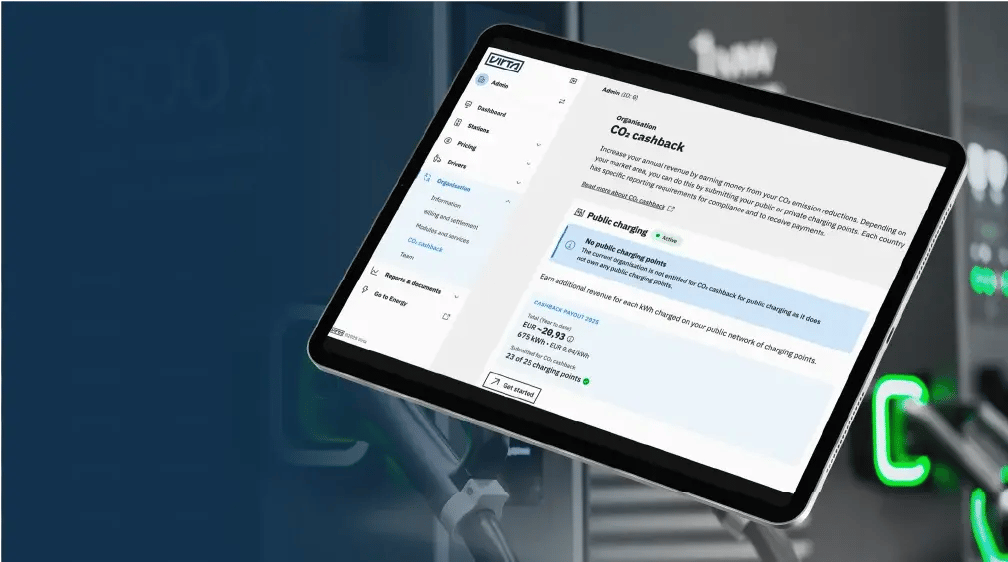
They are different products that stack on the same infrastructure. CO2 Cashback converts charging volume into carbon credits and pays out per kWh charged, at a fixed rate. Flexibility pays for charging capacity or shifted energy, at market prices. Many operators are eligible for both.

Back to top

Related services

Find out what your network could earn

Leave your details and our energy team will model your network's flexibility potential, market by market. No commitment, and no changes to your charging operations required to find out.