
Qualified charging flexibility can earn FCR-D capacity payments in Finland and Sweden, but the bid thresholds, prices and market rules differ on each side of the border.
Nordic electricity grids use frequency reserves to keep electricity production and consumption balanced around a nominal frequency of 50 Hz. When a disturbance pushes frequency outside its normal operating range, Frequency Containment Reserve for Disturbances (FCR-D) responds automatically to contain the deviation.
For EV charging operators, this creates an opportunity to earn additional revenue from controllable charging demand. The payment is for qualified reserve capacity that is contracted and maintained, not simply for having chargers connected.
This blog post explains how FCR-D works, what makes a charging network suitable, and why operators need to distinguish between Finnish and Swedish market rules when building their business case.
Key takeaways on FCR-D revenue
- Up is the product charging networks serve: FCR-D Up and FCR-D Down are procured separately. A charging load provides FCR-D Up by reducing consumption, which is where charging networks take part in practice.
- Market-specific minimum bids: Fingrid lists 1 MW for Finnish FCR-D, while Svenska kraftnät lists 0.1 MW for Swedish FCR-D Up.
- Aggregation, within limits: smaller charging resources can be combined, but bids must reflect deliverable flexibility, not installed charger capacity.
- Connectivity is not eligibility: Open Charge Point Protocol (OCPP) support alone does not establish it. Frequency measurement, control performance, metering and prequalification all matter.
- The hourly market is where charging portfolios earn: a separate marginal price is set for each hour, and from 2027 Finnish procurement moves there entirely.
All figures here were checked against Fingrid and Svenska kraftnät sources in October 2026. Reserve prices and volume requirements change, so confirm the current numbers for your market before putting them into a business case.
FCR-D and its role in grid stability
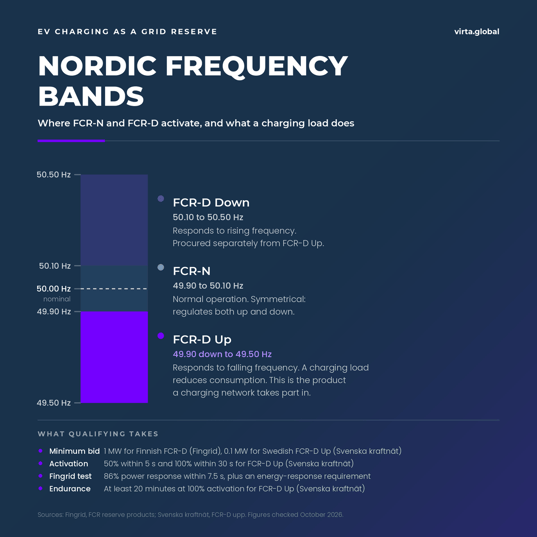
FCR-D stands for Frequency Containment Reserve for Disturbances. Nordic transmission system operators (TSOs), including Fingrid in Finland and Svenska kraftnät in Sweden, procure it to contain frequency deviations outside the normal 49.9–50.1 Hz range.
FCR-D Up responds to falling frequency. A participating charging load reduces consumption, helping contain the decline. FCR-D Down is the opposite product, procured separately for rising frequency, and it is not generally where a charging network participates.
Reserve requirements are not a fixed Nordic volume in every operating situation. Svenska kraftnät explains that FCR-D Up requirements depend on the dimensioning incident and can vary during the year. Its maximum requirement is based on Oskarshamn 3 operating at full output, which implies a Nordic dimensioning incident of 1,450 MW.
How FCR-D differs from other reserves
FCR-N, Frequency Containment Reserve for Normal Operation, supports frequency within the normal range. It is a symmetrical product requiring both upward and downward regulation. FCR-D is procured separately for each direction.
Other reserve products include automatic Frequency Restoration Reserve (aFRR), manual Frequency Restoration Reserve (mFRR) and Fast Frequency Reserve (FFR). Their control methods and technical requirements differ, so qualification for one does not automatically qualify a charging portfolio for another.
FCR-D performance cannot be reduced to a single activation-speed figure. Svenska kraftnät states 50% within 5 seconds and 100% within 30 seconds for FCR-D Up, while Fingrid's technical summary specifies a power response of 86% within 7.5 seconds under its defined test, alongside energy-response and other requirements. Compliance must be demonstrated through prequalification.
How can your charging network provide FCR-D?
A charging vehicle is an adjustable electrical load. For FCR-D Up, reserve capacity comes from consumption that can actually be reduced. An idle charger or a fully charged vehicle does not automatically provide it.
Aggregation pools eligible resources into a portfolio. In Finland, Fingrid lists a minimum FCR-D bid of 1 MW. In Sweden, Svenska kraftnät lists 0.1 MW for FCR-D Up. Operators should confirm the relevant product's current rules rather than applying one threshold across the Nordics.
Automatic FCR activation is based on measured frequency. Fingrid does not send an activation command for FCR. OCPP can support charging control, but charger response, communications, frequency measurement and metering must work together as a compliant system.
Your energy management assessment should therefore start with charging-session data and verified control performance, not the sum of charger nameplate ratings.
What FCR-D capacity payments are worth
FCR-D capacity payments compensate providers for maintaining contracted reserve, whether or not it is activated. Payment still depends on meeting delivery obligations. Fingrid verifies maintained capacity using measurement data, and shortfalls can reduce payments and incur sanctions.
Charging portfolios earn in the hourly market, where a separate marginal price is set for each hour and every accepted provider is paid the same price for that hour. Fingrid publishes the realised Finnish hourly-market transactions for FCR-D Up, and that is the series to build a business case on. Annual-auction figures are a different product with different economics, and from 2027 they disappear altogether, since Fingrid is concentrating domestic FCR procurement on the hourly market and holding no yearly auction.
Hourly-market prices vary. For Sweden and Denmark's DK2 area, Svenska kraftnät's Mimer dashboard publishes prices and procured volumes by product and auction. Its “Total” price is a volume-weighted average of the two auctions' marginal prices, not necessarily the price paid for an individual accepted bid. The dashboard excludes trade between TSOs and uses Central European Time and Central European Summer Time (CET/CEST) timestamps.
Build your revenue estimate from deliverable reserve capacity, realistic accepted hours and prices for the relevant product and market. Then account for service-provider fees, charging constraints, energy costs and any delivery shortfalls. Virta works on a revenue-sharing model, which means the commercial terms matter as much as the market price. Gross reserve-market revenue is not the same as your network's net income.
Network types best suited to FCR-D
Direct current (DC) fast-charging hubs can contribute substantial adjustable demand when vehicles are actively charging. Their suitability depends on concurrent load, response performance and how much flexibility can be offered without compromising the charging service.
Long-dwell alternating current (AC) networks at workplaces, homes, hotels and other destinations may offer scheduling flexibility across many sessions. Fleet depots add known departure times, allowing operators to assess flexibility against required energy delivery.
Neither AC nor DC charging qualifies automatically. The relevant question is how much reserve your portfolio can reliably maintain during each contracted period.
What activation means for EV drivers
FCR-D activation changes charging power, and the operator sets how much. The maximum power drop is defined by the charge point operator, so participation stays within limits you choose.
In practice the adjustments are small and brief. Power reductions happen a few times a day and typically last well under a minute. Across Virta's own portfolio in 2025, only three events during the whole year called for more than 50% of contracted capacity, and each of those lasted a few minutes.
That leaves the driver experience intact in normal operation. Departure schedules still need respecting, and the flexibility you sell has to stay compatible with your charging commitments.
What does prequalification involve?
Before participating, resources must demonstrate compliance with the TSO's technical requirements. The assessment covers response to frequency changes, control behaviour and measurement performance. Providers must also meet contractual and data-exchange obligations.
Compatibility depends on the complete control architecture, charger model, firmware and site configuration. Most networks can use their existing infrastructure, though some sites need additional measurement or control equipment. Software connectivity alone is not a guarantee of qualification.
Finnish and Swedish market rules compared
Fingrid has procured FCR through both a yearly and an hourly market in Finland, with the annual auction setting a fixed price for the following calendar year and hourly procurement setting a separate marginal price for each hour. From 2027 the yearly market is being retired and domestic procurement moves to the hourly market only. The reserve products are traded separately in either case.
Swedish FCR-D Up is procured through two complementary auctions on the day before delivery. Sweden shares an FCR market with Denmark's DK2 area. Accepted bids receive the marginal price of the auction in which they were procured.
Sweden has one more structural requirement. The electricity reseller has to sit in the chain, so a charge point operator needs a centralised electricity supplier, or the willingness to move to the supplier its service provider works with. A network with electricity contracts spread across many sites has that to resolve first.
This distinction matters: Finland's market model should not be presented as a uniform Nordic arrangement, and from 2027 the two countries diverge further. Operators in Norway or other Danish bidding zones need to check the applicable local market and product rules.
How to start earning FCR-D revenue
FCR-D can turn qualified charging flexibility into an additional revenue stream. The business case rests on reliable delivery, market-specific rules and a clear agreement on how revenue and responsibilities are shared.
Start by assessing your charging-session patterns, controllable demand, vehicle requirements and technical compatibility. The Virta charging platform and energy management offering connect charging operations with grid flexibility. Send us your site list and a month of charging-session data, and the energy team will come back with an estimate of the reserve capacity your network could realistically qualify to offer, and what the net revenue would look like after costs.


Electric vehicles as Frequency Containment Reserves

Charging electric company cars at home: What to consider

Build or buy a CPMS? A decision framework for charge point operators


